The Sagrada Familia is Spain’s most visited attraction with 4.8 million visitors per year. We had to book our tickets several weeks in advance and it did not disappoint. Practically speaking, it is a Catholic church in Barcelona, Catalonia, Spain, but in reality, it is a one-of-a-kind artistic and architectural masterpiece on a scale that is impossible to imagine. Designed by the Catalan architect Antoni Gaudí, it is the tallest church in the world. Its construction started in 1882 and it is still not finished. On 7 November 2010, Pope Benedict XVI consecrated the church and proclaimed it a basilica. Parts of the Sagrada Família (Nativity façade and Crypt) were declared as a UNESCO World Heritage Site in 2005, under “Works of Antoni Gaudí”. As with anything so unique and stunning, and especially on such a grand scale, it is also controversial. From my simple perspective as an art lover, it is creative and gorgeous.
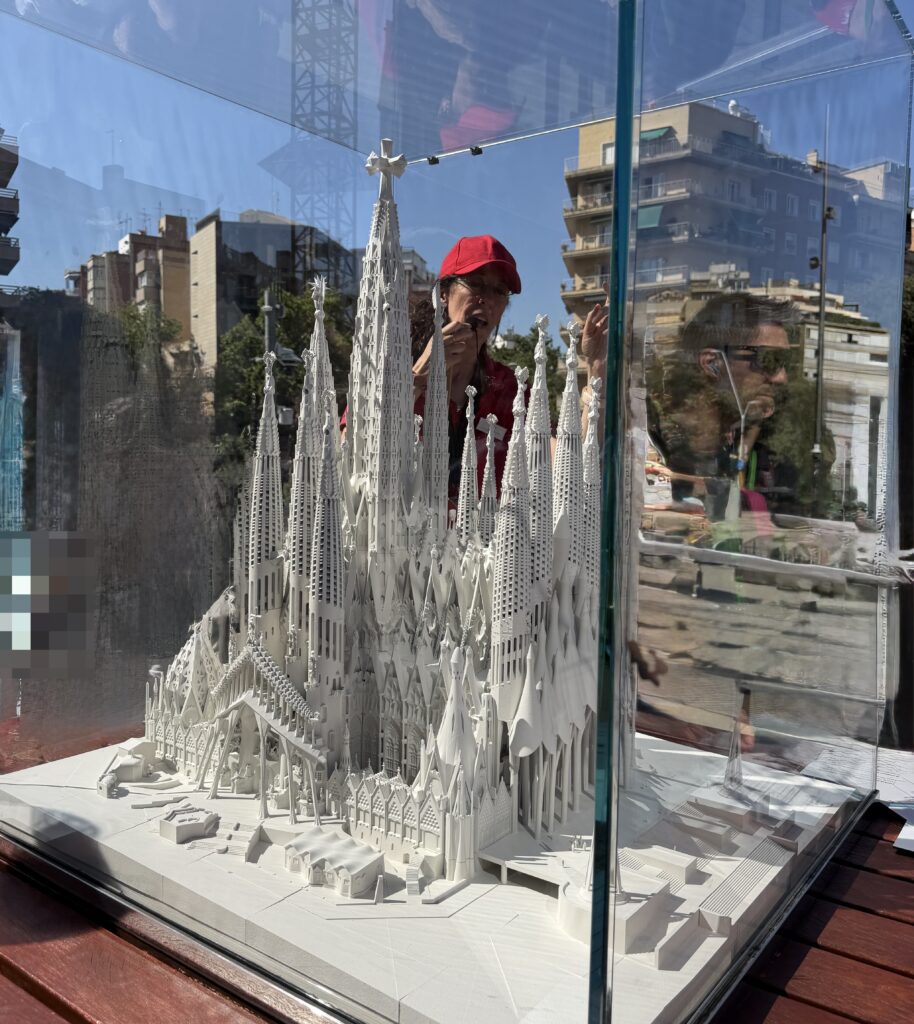
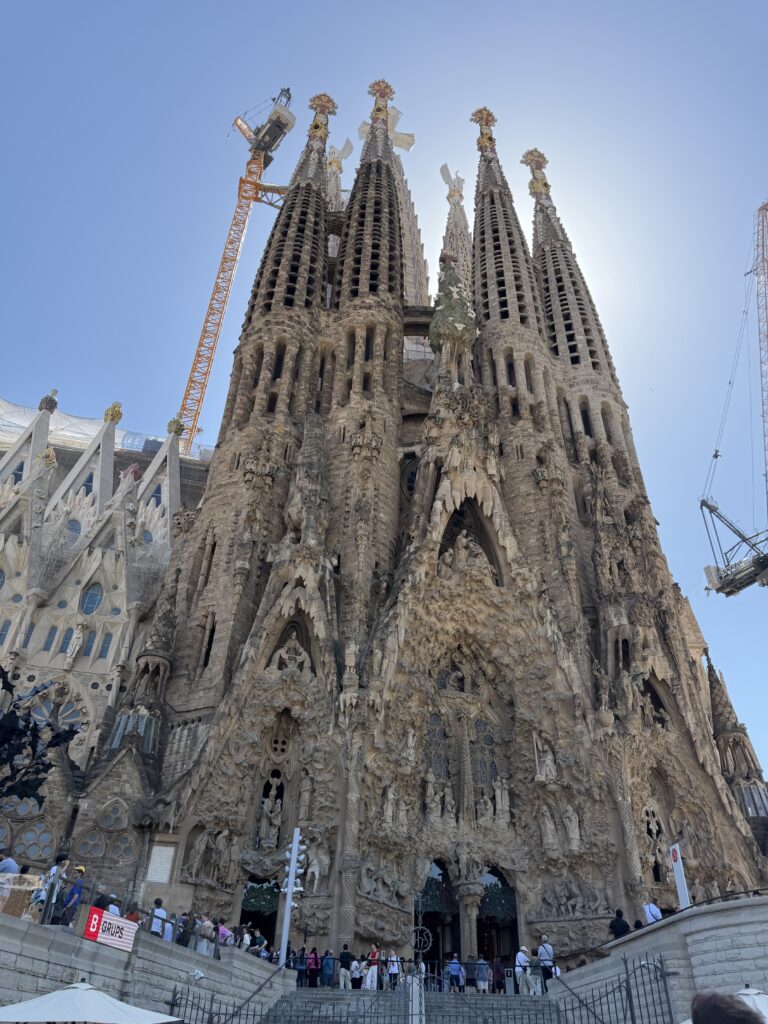
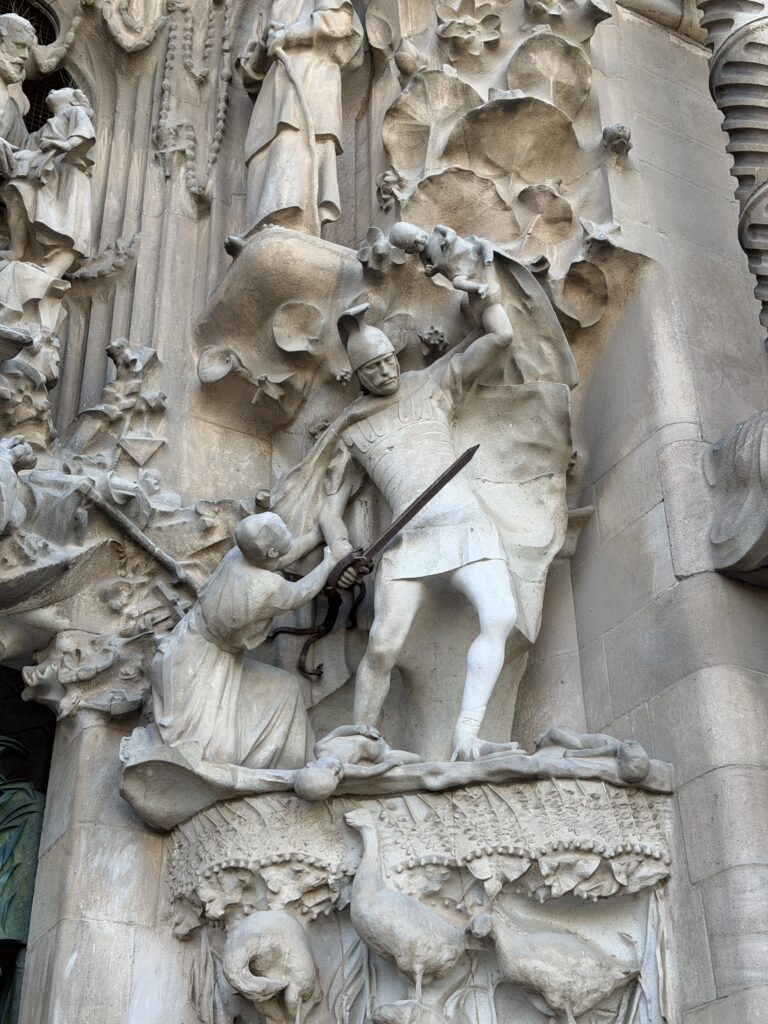
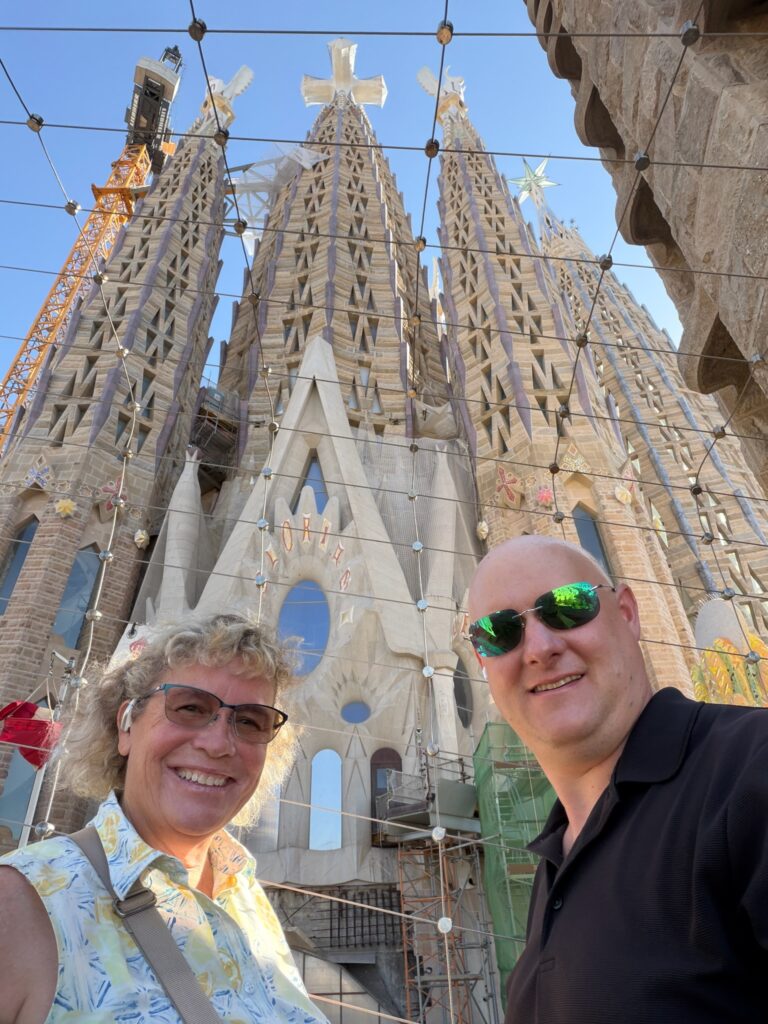
We took a guided tour, which started at a mockup of what the fully completed church / basilica will look like. Construction on Sagrada Família is not supported by any government or official church sources. Private patrons funded the initial stages. Money from tickets purchased by tourists is now used to pay for the work, and private donations are accepted. In October 2018, Sagrada Família trustees agreed to pay city authorities €36 million for a building permit, after 136 years of unlicensed construction. Most of the funds would be directed to improve the access between the church and the Barcelona Metro. The permit was issued by the city on 7 June 2019The church is designed to have three grand facades: the Nativity facade to the east, the Passion facade to the west, and the Glory facade to the south, which is still incomplete. The facade in this photo is the Nativity Facade and it contains dozens of biblical narratives in ornately carved stone. The nativity facade was also the first facade constructed and was almost finished by the time Antoni Gaudí died in 1926. Visitors enter through this facade.This grim scene on the Nativity façade is known as the Massacre of the Innocents. Located within the Portal of Hope (the left portal dedicated to St. Joseph), it portrays King Herod’s soldiers hunting down and slaying infant boys in BethlehemAs you enter the structure you are struck by its sheer size, which is enormous. The supporting columns were made to look like trees, with branches, mimicking nature.
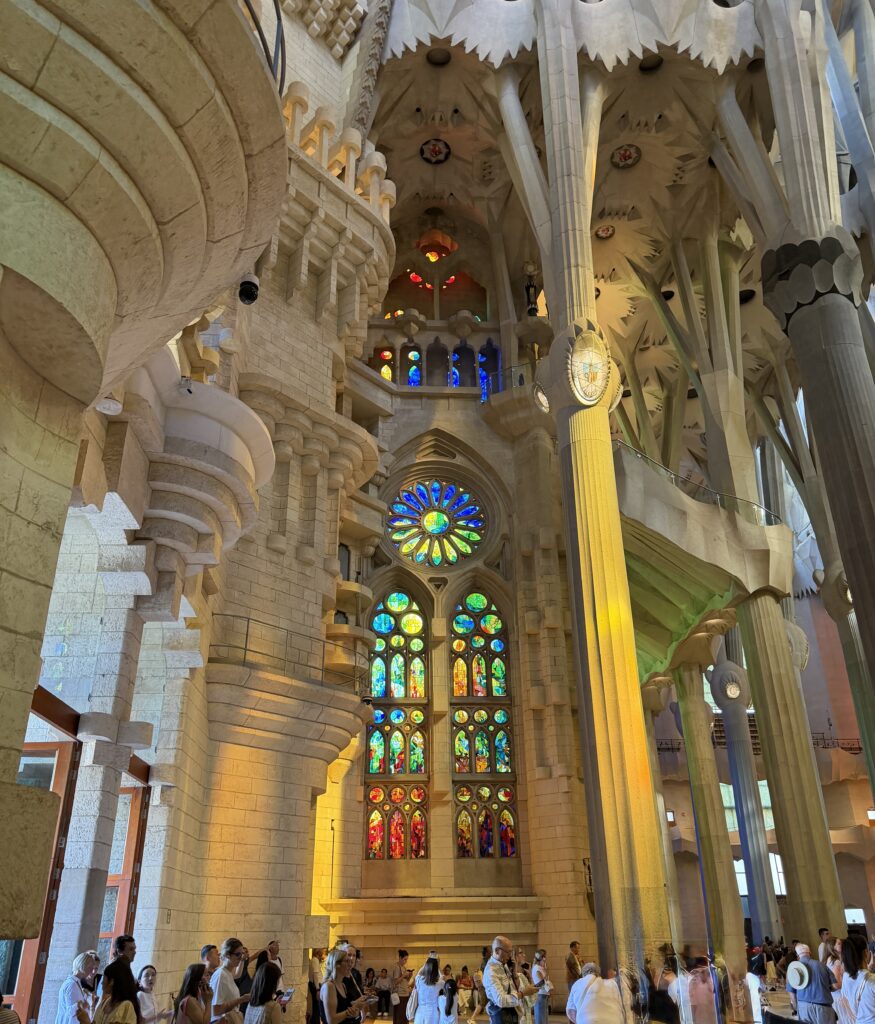
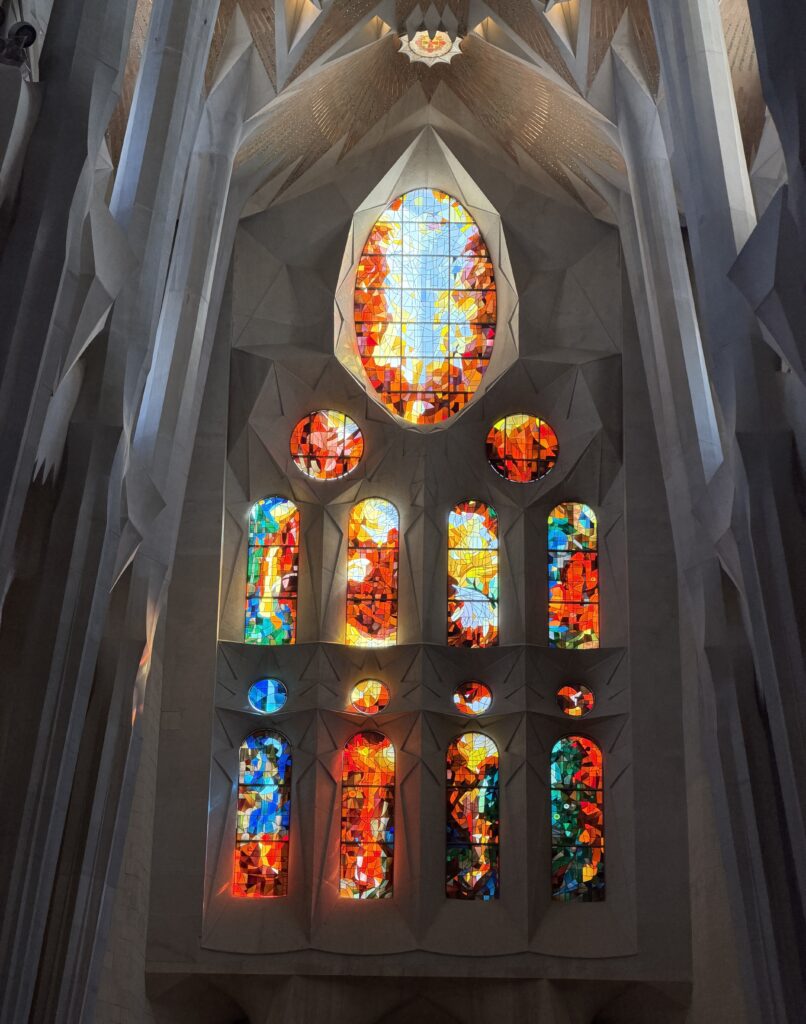
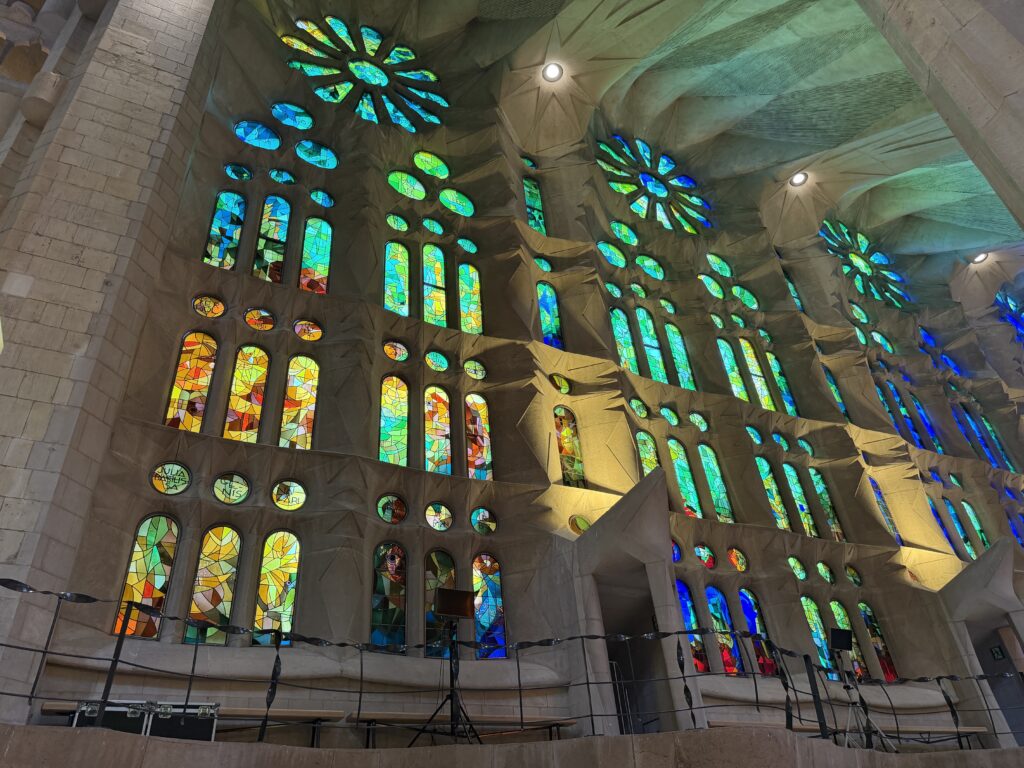
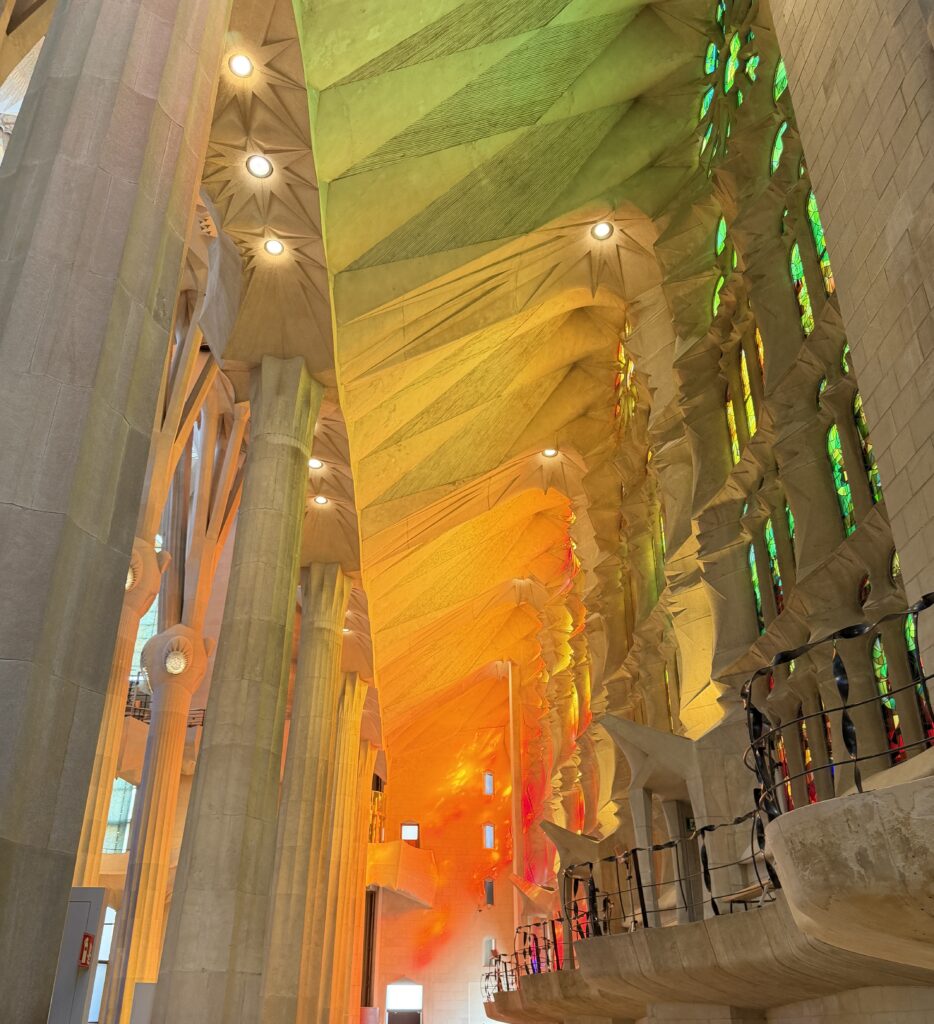
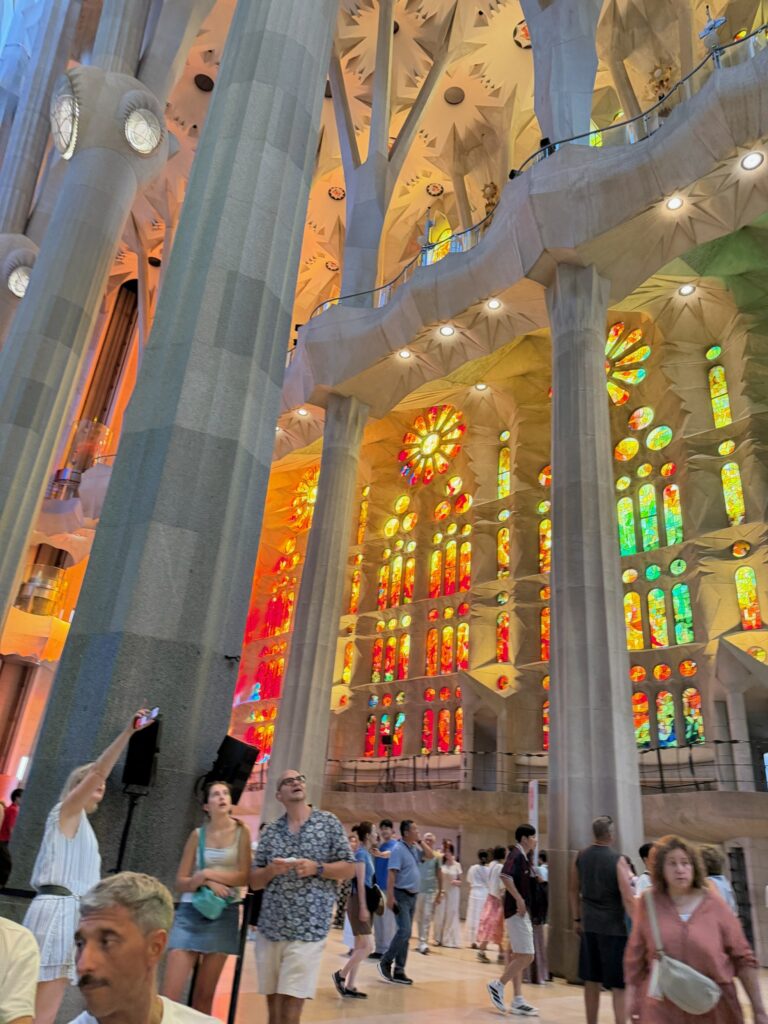
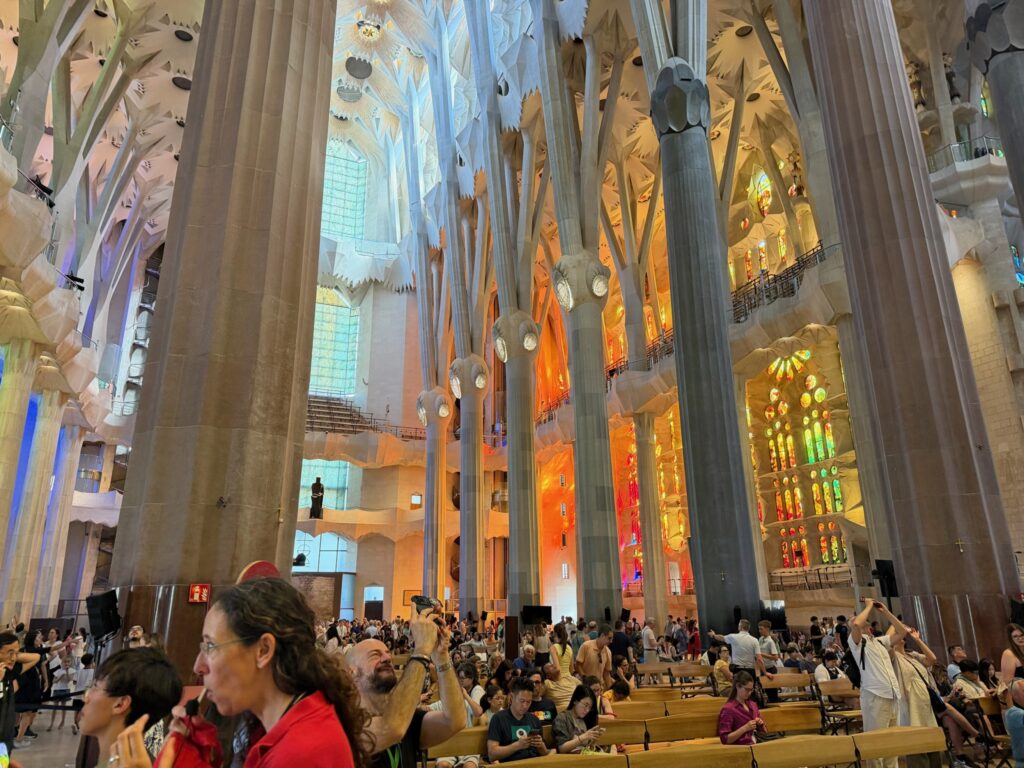
In Sagrada Familia, the stained glass windows are in a league of their own. They use vibrant colors to transform sunlight into architectural light. The windows are purposefully graded: Morning light (Nativity Façade): Features cool greens and blues. Afternoon light (Passion Façade): Transitions to warm, deep reds and oranges. Eye-level brilliance: The most intensely colored windows are placed at eye level, while the upper panes use transparent, colorless glass so the sun can naturally illuminate the golden vaultsThese are the winter and morning windows with cooler light.We were there in the late afternoon, where the sun blazed through the windows of the Passion facade. This photo, and all of the photos within this Blog post, were taken by our iPhones without any filters, enhancements, or touch-ups.The light through the windows changed as we stood there, evolving more toward the colors of sunset as the afternoon went by.This is a good view of the tree – like columns supporting the structure. The Sagrada Familia’s supporting columns are engineered as a branching tree canopy. The 36 angled, double-helix torsion pillars are made of diverse, highly durable stones like porphyry, granite, and basalt. This specialized geometry eliminates the need for external flying buttresses, dispersing immense overhead weight directly to the ground
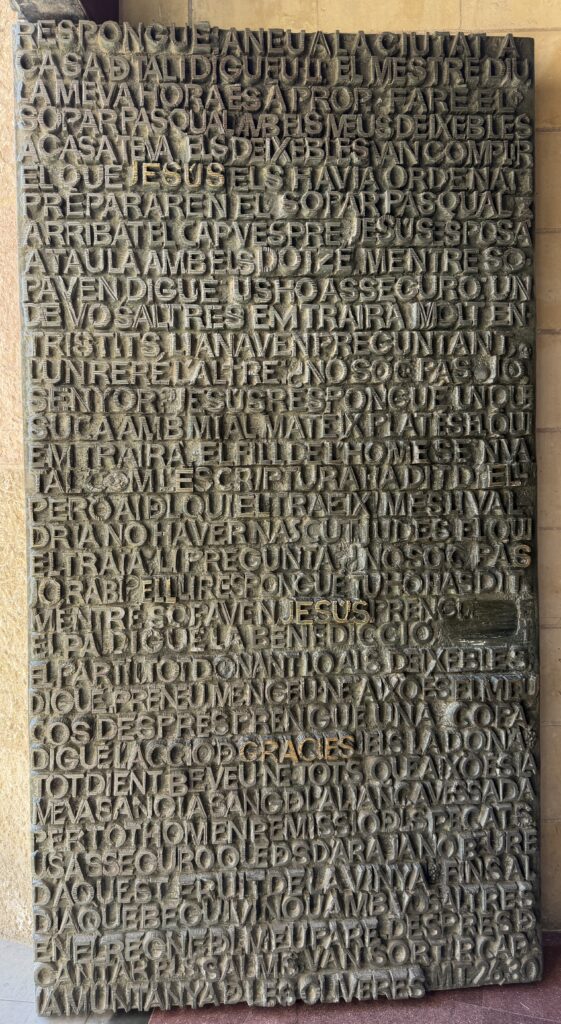
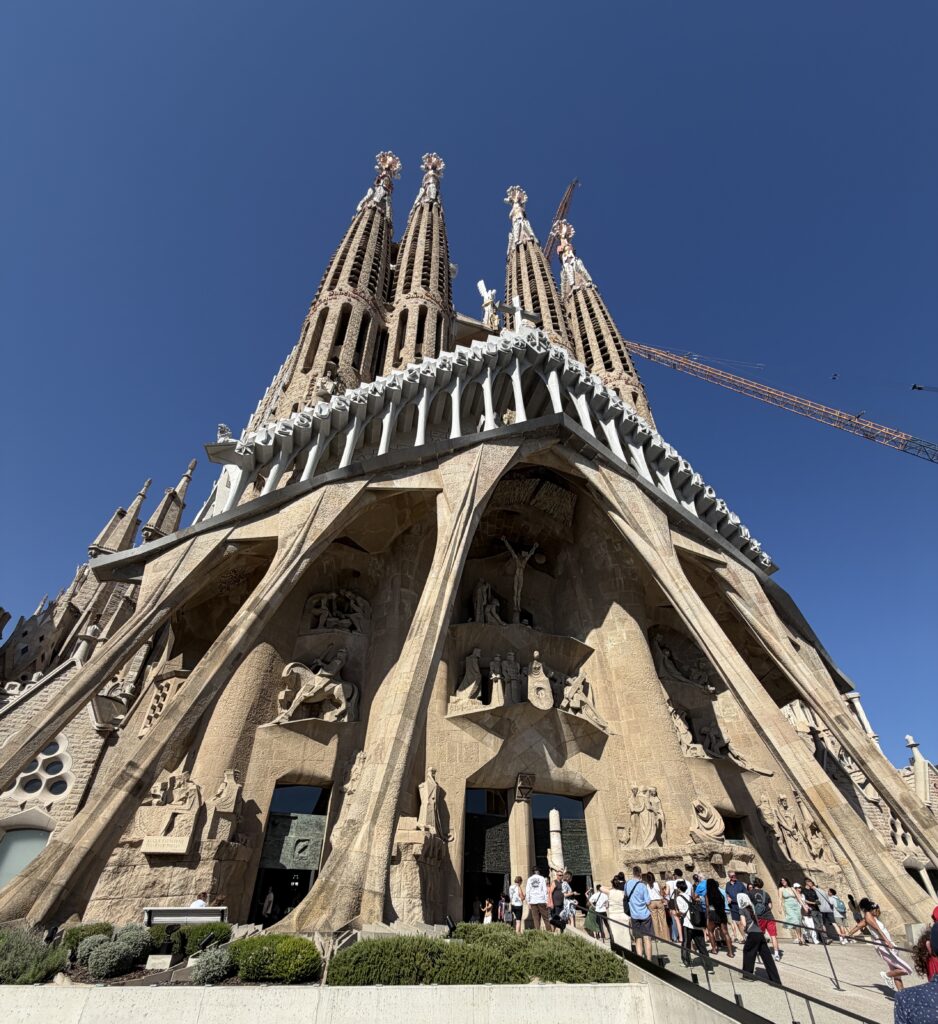
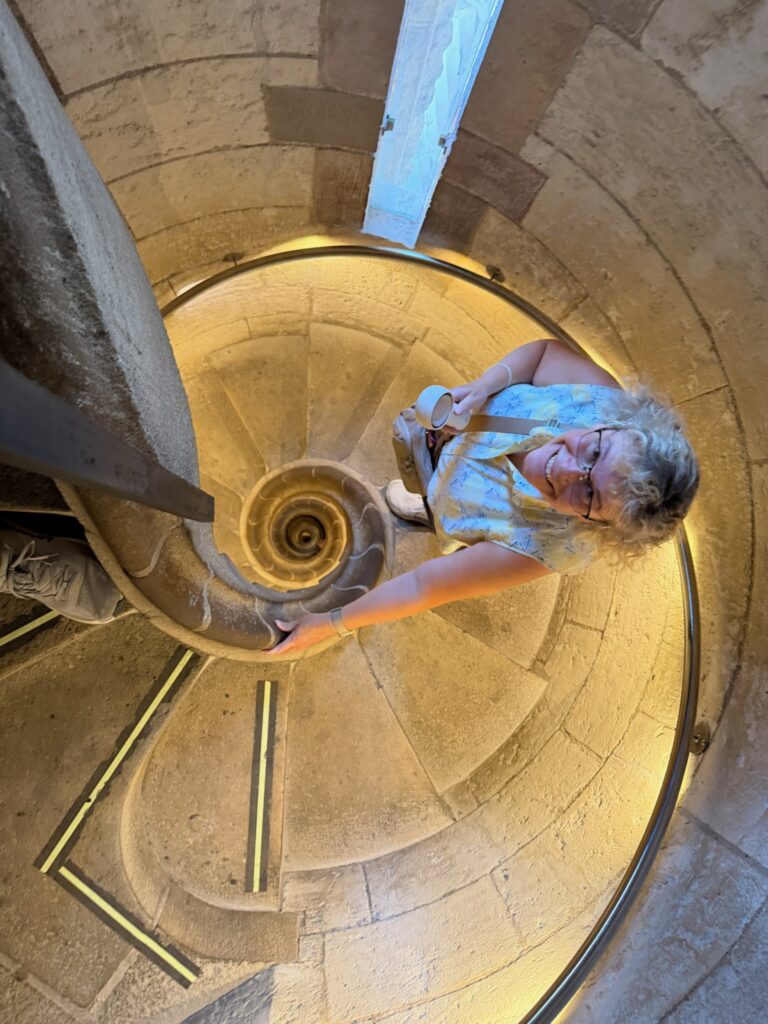
The massive bronze doors of the Passion Façade at the Basílica de la Sagrada Família were sculpted by the Catalan artist Josep Maria Subirachs and installed in 2005. They dramatically tell the story of the final days of Jesus Christ’s life in a raw, angular style that sharply contrasts with the softer, organic aesthetic of the rest of the basilicaThis is the view of the Passion facade, which is opposite the Nativity facade. The Passion Façade commemorates the suffering, death, and resurrection of Jesus Christ. Designed by architect Antoni Gaudí to convey the harshness and cruelty of the crucifixion, it relies on stark, angular, and expressionist sculptures to evoke a somber, emotional response.The façade is broken down into multiple key elements that tell the story of the final days of Jesus: Unlike the joyous and highly ornate Nativity façade, this side features bare, bone-like columns and angled lines to represent pain and sacrifice.There is an elevator to take you up into some of the towers, but you have to come down via stairs, including this tight spiral for many floors.We went up into the Nativity facade towers, which facilitated great views to the east of Barcelona and the Mediterranean Sea. Even though we were quite a ways up, the Nativity Facade towers still soared high above us.
Feel free to leave a comment. If you leave a comment it will not show up right away. We have it set up so that we have to approve comments before they can show here (we do have to filter out spam unfortunately). We check for (and respond to) comments almost every day so you should be able to see it here soon.
4 Comments
That is absolutely stunning! Why is it controversial? The pictures with the lights without touch-ups are gorgeous.
I love all your pics and the information.that you give with it!
Hi Lisa, Thanks for following our blog. That is a great question about the controversies – you have given me the chance to summarize it. Our tour guide explained some of them:
1 – Extreme Aesthetics: The basilica has a highly unusual and organic style that is simply not pleasing to many people. Author George Orwell described it as one of the most hideous buildings in the world and critics over the decades have likened its aesthetic to everything from a gingerbread house to a termites’ nest. From my personal perspective it is exactly this organic style (use of tree-like columns and architectural lighting through stained glass windows) that I find so refreshing. We have been in a lot of old ornate cathedrals and churches and this is unlike anything we have ever seen.
2 – Design & Authenticity: Because Gaudí died in 1926 just before the first of the three facades were finished, modern architects have had to interpret his vision to continue building. Our guide indicated that Gaudi had always said that the next Facades would be for future generations to build, so stopping construction would stop Gaudi’s intent, which the purists are supposedly trying to protect. Does not make sense to me.
3 – Planned Future Construction: The third and final facade (Glory Facade) is only partially started and its designs will require changes to the adjacent street and city blocks, and the people and business who will be impacted are upset. I can certainly appreciate this aspect of controversy.
4 – Mass Tourism and Urban Strain: The millions of annual tourists cause congestion, drive up local living costs, and disrupt everyday life in the Eixample district. I can also appreciate this aspect of controversy


That is absolutely stunning! Why is it controversial? The pictures with the lights without touch-ups are gorgeous.
I love all your pics and the information.that you give with it!
Hi Lisa, Thanks for following our blog. That is a great question about the controversies – you have given me the chance to summarize it. Our tour guide explained some of them:
1 – Extreme Aesthetics: The basilica has a highly unusual and organic style that is simply not pleasing to many people. Author George Orwell described it as one of the most hideous buildings in the world and critics over the decades have likened its aesthetic to everything from a gingerbread house to a termites’ nest. From my personal perspective it is exactly this organic style (use of tree-like columns and architectural lighting through stained glass windows) that I find so refreshing. We have been in a lot of old ornate cathedrals and churches and this is unlike anything we have ever seen.
2 – Design & Authenticity: Because Gaudí died in 1926 just before the first of the three facades were finished, modern architects have had to interpret his vision to continue building. Our guide indicated that Gaudi had always said that the next Facades would be for future generations to build, so stopping construction would stop Gaudi’s intent, which the purists are supposedly trying to protect. Does not make sense to me.
3 – Planned Future Construction: The third and final facade (Glory Facade) is only partially started and its designs will require changes to the adjacent street and city blocks, and the people and business who will be impacted are upset. I can certainly appreciate this aspect of controversy.
4 – Mass Tourism and Urban Strain: The millions of annual tourists cause congestion, drive up local living costs, and disrupt everyday life in the Eixample district. I can also appreciate this aspect of controversy
Absolutely beautiful!
We agree!